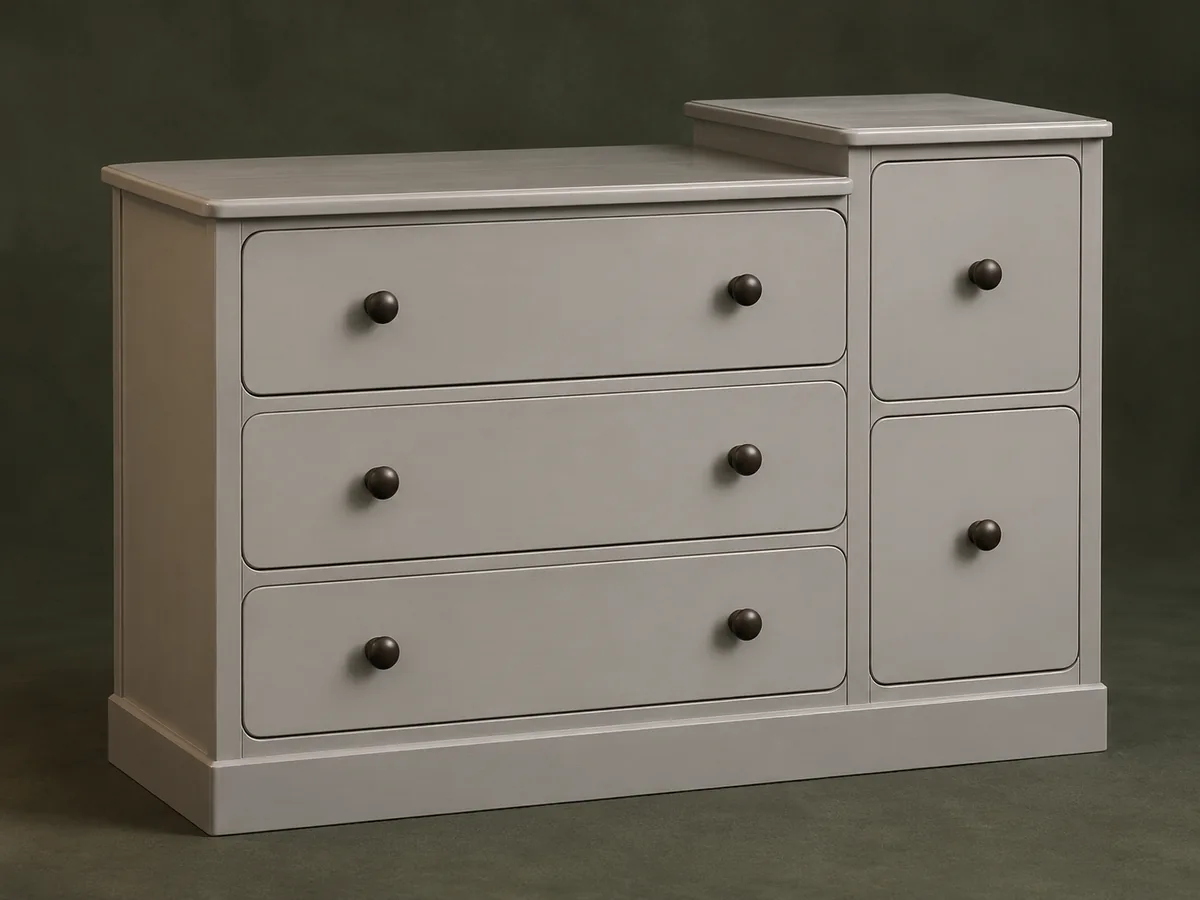
Three wide drawers occupy the lower left bay.
Project library / Beds & nursery
Beds & nursery / Design study
Stepped Nursery Dresser
A pine dresser combines three broad drawers and two narrow drawers beneath two different-height tops.
Advanced6 stages6-page source
Design review required. Historical nursery concept only. Current changing-product requirements, stability, anti-tip attachment, barriers and any restraint system require qualified review before infant use. This guide has not been shop-tested.
Understand the project
What makes this build.
The stepped frame and five drawers require accurate cabinet fitting, while changing-table use adds unresolved current safety requirements.
Two deeper narrow drawers occupy the raised right bay.
The doubled central frame supports the change in top height.
Points to resolve before building
- The source does not establish compliance with current changing-product or clothing-storage requirements.
- Historical drawer dimensions and slides must be reconciled before cutting.
Prepare the workbench
Materials & tools.
Check what you have, then confirm stock sizes and hardware against your chosen dimensions.
Materials checklist
Tools & operations
- Router
- Drill
- Saw
- Clamps
- Sander
Tool choices may include practical editorial suggestions. Use workholding and guarding appropriate to the actual machine and operation.
Choose dry, sound stock and test unfamiliar joints in scrap. Keep guards, push aids, eye protection, and dust control appropriate to the work.
Keep the numbers close
Measurements to know.
Selected dimensions verified from the source. This is not an automatically scaled cutting list.
| Lower top | 19½ × 34¼ × ½ in | Source p. 2 |
|---|---|---|
| Upper top | 19½ × 18½ × ½ in | Source p. 2 |
Printed diagrams and concept images are not scale references. Verify measurements, material thickness, hardware fit, and allowances before cutting.
Inches to millimeters
Convert a measurement without changing the design. Enter a decimal or a fraction, such as 1 3/8.
Nominal lumber names and actual finished sizes are different. Converting units does not choose a substitute stock size.
Read, assess & plan
Explore the construction.
Review stages explain the historical design and unresolved decisions; they are not approval to build or use it.
Review nursery suitability
- Treat the historical changing-table label as an unverified intended use. Have current changing-product requirements, restraint and barrier details, stability and anti-tip attachment resolved before any infant use. The review must consider the actual pad or other top equipment rather than treating the two plywood platforms as a complete changing system.
Before moving onA competent review has resolved the intended use.
Map the stepped frames
- Lay out the front and rear frames with the broad lower bay and narrow taller bay. Identify the doubled center uprights and matching lap joints before cutting. Label the center uprights left and right and mark their back faces; the lapped recesses must be hidden behind the finished front.
Before moving onFront and rear agree at the stepped center.
Prepare panel assemblies
- Fit the side frames and their plywood infill into the rear-edge rebates. Dry-fit these assemblies between the front and rear before adding the small step panel. Confirm the side panel heights independently because the raised right bay uses a taller frame than the broad drawer bay.
Before moving onThe cabinet is square without clamp-induced twist.
Fit tops and base trim
- Fit the two plywood tops to their individual overhangs and add edge strips. Miter the shaped base trim and verify that it does not hide weak or uneven support. The small panel at the height change is part of the cabinet assembly and should be fitted before top trim hides its connections.
Before moving onBoth tops are fully supported and the base sits evenly.
Fit the five drawers
- Make drawer boxes with captured bottoms and fit slides to the actual hardware clearances. Align the separate fronts and knobs before installing the back panels. Measure drawer-slide clearances from the assembled openings; historical nominal drawer widths should not override the current hardware requirements.
Before moving onEach drawer travels without binding or striking an adjacent front.
Complete use review
- Finish all surfaces and install the reviewed anti-tip restraint. Do not use the top for changing until the product-specific safety review is complete. Any unresolved barrier, restraint or stability detail keeps this project at the planning stage, regardless of how complete the woodworking appears.
Before moving onAll conditions of the review are satisfied before nursery use.
1 / 6
Progress and notes stay in this browser. Nothing is uploaded.
Source notes.
- Original PDF
- Baby Changing Table.pdf
- Source length
- 6 pages
- Attribution
- Collection copyright 2004 Martian Auctions; original authorship unverified.
- This edition
- 116 Studio · Original written companion and AI concept image · November 2026
Page references count from the first page of this PDF. The original is retained in the owner’s private woodworking collection; it is not distributed by this website. Consult it for full drawings, templates, and details beyond this companion.
Current reference for design review: CPSC guidance for baby changing products, CPSC guidance for clothing storage units.
Historical plans can omit essential context. Source references identify where a detail came from; they do not certify the design or replace current manufacturer instructions or applicable professional review.
More from this corner of the shop.
 Design study
Beds & nursery
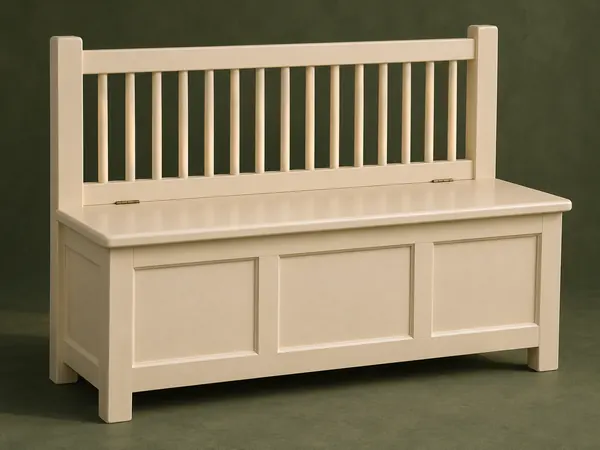
Spindle-Back Toy Chest
A storage chest takes the form of a small bench with a dowel-spindle back and a hinged seat lid.
Advanced5 stages
 Design study
Beds & nursery
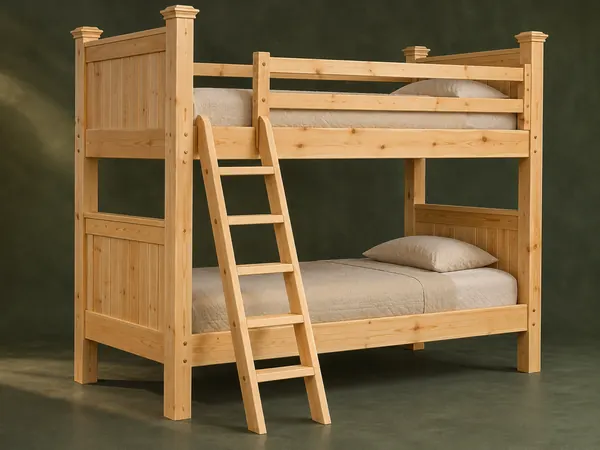
Paneled Timber Bunk Beds
A substantial twin-bunk concept uses paneled ends, laminated posts, wooden mattress slats and a separate ladder.
Advanced5 stages
 Design study
Beds & nursery
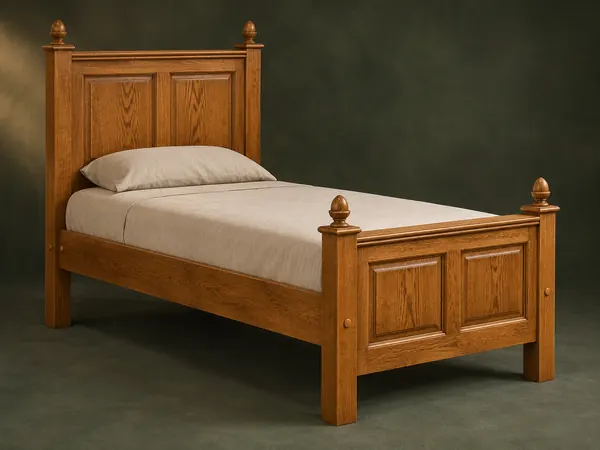
Paneled Oak Single Bed
A traditional oak single-bed concept has paneled ends, acorn finials and bolted mortise-and-tenon rails.
Advanced5 stages