Folding geometry and saw-stand loads need machine-specific review.
Project library / Workshop
Workshop / Design study
Folding Outfeed Table
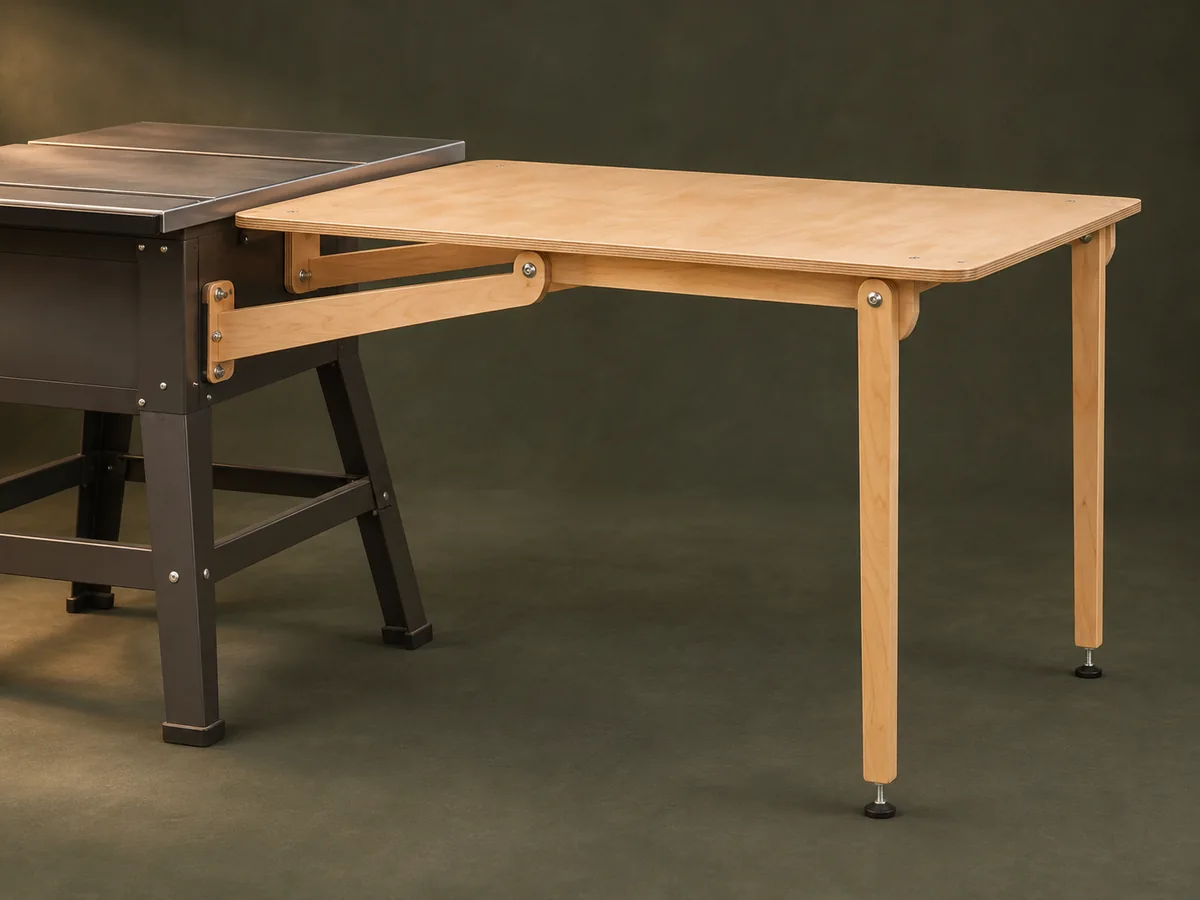
A folding plywood outfeed platform with pivoting legs, drawn for a Ryobi table-saw stand.
Intermediate5 stages3-page source
Design review required. Incomplete archival machine accessory: three of five numbered pages supplied. Resolve compatibility, retention and support before construction. This guide has not been shop-tested.
Understand the project
What makes this build.
Folding geometry and saw-stand loads need machine-specific review.
The two legs are staggered so they can nest when folded.
Points to resolve before building
- Only three of the original five numbered pages are present; no load rating or universal saw compatibility is established.
Prepare the workbench
Materials & tools.
Check what you have, then confirm stock sizes and hardware against your chosen dimensions.
Materials checklist
Tools & operations
- Saw
- Drill
- Square
Tool choices may include practical editorial suggestions. Use workholding and guarding appropriate to the actual machine and operation.
Choose dry, sound stock and test unfamiliar joints in scrap. Keep guards, push aids, eye protection, and dust control appropriate to the work.
Keep the numbers close
Measurements to know.
Selected dimensions verified from the source. This is not an automatically scaled cutting list.
| Top width shown | 42 in | Source p. 1 |
|---|---|---|
| Top material | ¼-in plywood | Source p. 3 |
Printed diagrams and concept images are not scale references. Verify measurements, material thickness, hardware fit, and allowances before cutting.
Inches to millimeters
Convert a measurement without changing the design. Enter a decimal or a fraction, such as 1 3/8.
Nominal lumber names and actual finished sizes are different. Converting units does not choose a substitute stock size.
Read, assess & plan
Explore the construction.
Review stages explain the historical design and unresolved decisions; they are not approval to build or use it.
Verify the missing context
- The supplied file contains pages numbered one through three of five. Obtain or reconstruct the missing details and measure the actual saw before cutting.
Before moving onA complete machine-specific drawing exists.
Fit the support frame
- Plan the half-lapped frame beneath the thin top, its overhang and the arms that pivot at the saw stand.
Before moving onTop has continuous practical support.
Review stand attachment
- Check the stand can carry the platform and supported work without destabilizing the saw. Specify secure mounting rather than copying bolt positions blindly.
Before moving onSaw stability is maintained.
Coordinate folding legs
- Mock up the staggered leg pivots and leveling bolts so the unequal legs fold past one another. Add positive deployed retention if the design requires it.
Before moving onLegs cannot collapse during use.
Check the work path
- Set the platform below the saw surface and test clearances with the machine unplugged, including fences, guards and miter-slot extensions.
Before moving onWork cannot catch or lift at the transition.
1 / 5
Progress and notes stay in this browser. Nothing is uploaded.
Source notes.
- Original PDF
- Feed Table.pdf
- Source length
- 3 pages
- Attribution
- DJM, Folding Outfeed Table for Ryobi Table Saw, December 1999.
- This edition
- 116 Studio · Original written companion and AI concept image · November 2026
Page references count from the first page of this PDF. The original is retained in the owner’s private woodworking collection; it is not distributed by this website. Consult it for full drawings, templates, and details beyond this companion.
Historical plans can omit essential context. Source references identify where a detail came from; they do not certify the design or replace current manufacturer instructions or applicable professional review.
More from this corner of the shop.
Workshop
Adjustable Studio Easel
A tall H-frame easel has a pegged canvas shelf, sliding top clamp and hinged rear tilt supports.
Intermediate6 stages
Workshop
Angled Router-Bit Shelf
A sloping drilled shelf presents router bits and other shanked accessories against a wall backboard.
Beginner5 stages
Workshop
Classic Wooden Bow Saw
An ash H-frame tensions a narrow saw blade with twisted cord and turned maple handles.
Advanced5 stages